
As June begins, Thailand enters its annual rainy season. High temperatures, elevated humidity, and rapidly changing weather conditions have become defining characteristics of this period. Alternating episodes of intense short-term rainfall and persistent heat create challenges for residents commuting to work as well as tourists traveling across the country. In response to Thailand’s unique rainy-season climate, MojiWeather offers a comprehensive range of AI-powered weather services, including AI radar precipitation forecasts, precise apparent temperature data, UV index forecasts, heatstroke risk assessments, and sunrise and sunset information, helping both local users and international visitors make informed travel

Thailand’s Rainy Season: Hot, Humid, and Highly Changeable
Thailand’s rainy season typically lasts from late May to mid-October each year. Driven by the southwest monsoon from the Indian Ocean, vast amounts of moisture are continuously transported into the region, making rainfall a dominant weather feature throughout the season. Unlike prolonged periods of continuous rain, Thailand’s rainy-season precipitation is often sudden and short-lived. Heavy downpours frequently develop in the late afternoon or evening, arriving rapidly and dissipating just as quickly, often followed by clear skies and sunshine.
Bangkok provides a typical example. In June, the city experiences an average high temperature of approximately 33.6°C, with average humidity levels reaching 74%, resulting in persistently muggy conditions. The city records around 16 rainy days during the month, while still enjoying roughly five hours of sunshine per day on average. The frequent alternation between intense sunshine and sudden thunderstorms makes weather conditions highly unpredictable.
One of the most notable weather phenomena is the evening “commuter rain.” During rush hour, torrential downpours often arrive with remarkable regularity, causing waterlogging, traffic congestion, and significant delays for commuters. Meanwhile, prolonged heat and humidity can make outdoor activities uncomfortable and increase health risks. Under such complex weather conditions, refined and highly localized weather services have become an essential daily necessity.
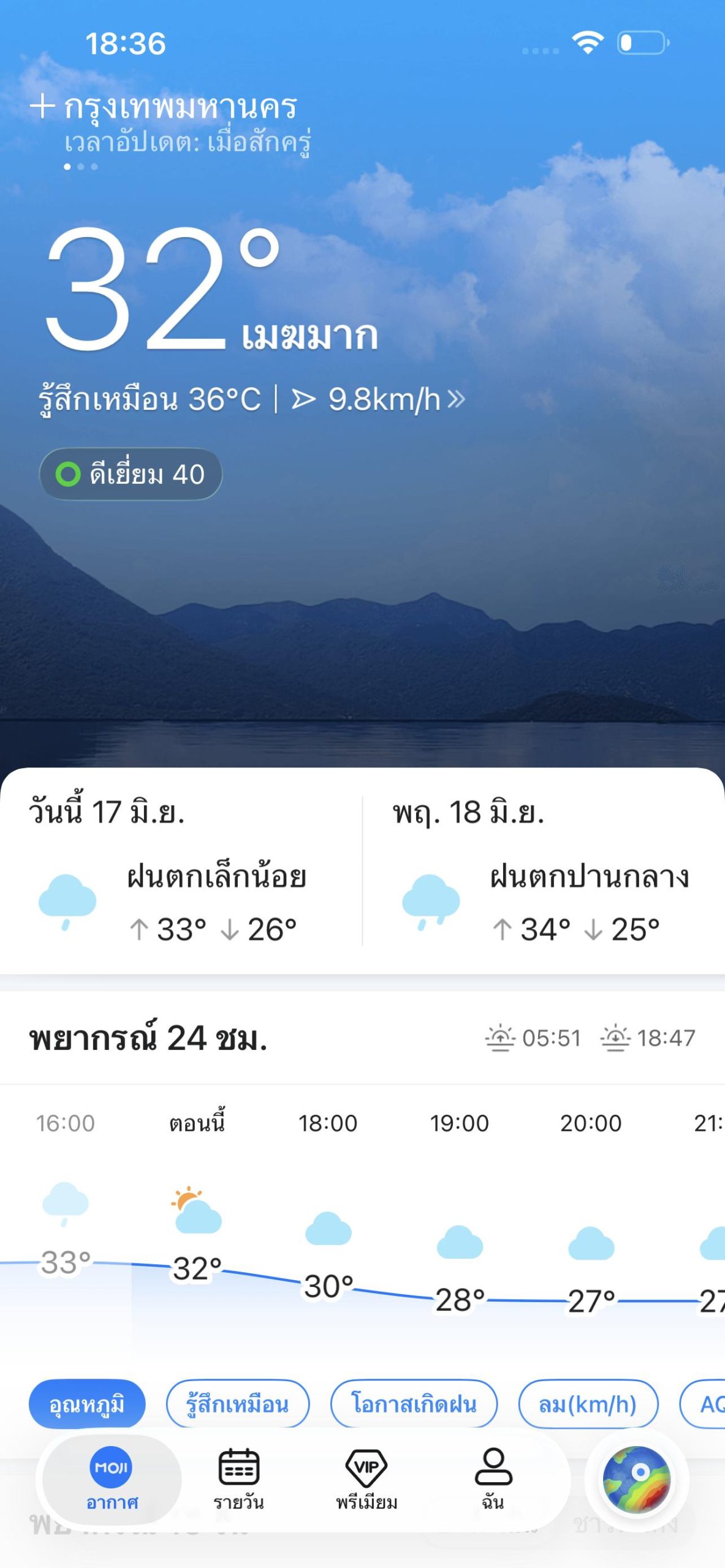
Refined Weather Services Address Travel Challenges
To help users navigate Thailand’s rainy season and its associated travel challenges, MojiWeather offers several key features:
AI Radar Precipitation Forecasts
Leveraging multi-source data integration from satellites, ground-based radar systems, and AI-powered correction algorithms, MojiWeather delivers minute-level, grid-based precipitation tracking. Users can monitor cloud movement, forecast rainfall locations and duration, and access highly accurate precipitation predictions, allowing them to avoid sudden showers, optimize commuting routes, adjust departure times, and reduce exposure to traffic disruptions.
Precise Apparent Temperature Forecasts
MojiWeather’s apparent temperature forecasts combine multiple environmental factors, including humidity, wind speed, and solar radiation, to reflect how hot and humid conditions actually feel to the human body. Unlike standard air temperature readings, apparent temperature provides a more realistic assessment of outdoor comfort levels, helping users better plan outdoor activities and work schedules.
Weather Notification Alerts
Supported by a localized meteorological database, MojiWeather identifies periods and regions with a high likelihood of thunderstorms and delivers timely weather alerts. For visitors traveling in Thailand, these notifications help facilitate flexible itinerary adjustments and reduce the risk of unexpected rainfall disrupting travel plans.
Heatstroke Risk Index
Thailand’s hot and humid June climate often results in apparent temperatures that significantly exceed measured air temperatures. Extended exposure to outdoor conditions can increase the likelihood of heat-related illnesses. MojiWeather’s Heatstroke Index evaluates risk levels by analyzing temperature, humidity, wind speed, and solar radiation, enabling users to better manage outdoor exposure and minimize health risks.
UV Index Forecasts
Located within the tropics, Thailand experiences strong solar radiation during June due to the high solar angle. Even on cloudy days, ultraviolet radiation can remain intense. MojiWeather’s UV Index provides practical sun protection recommendations, such as applying SPF 30+ sunscreen, helping users reduce the risk of sunburn during beach visits, sightseeing activities, and other outdoor experiences.
Sunrise and Sunset Information
Thailand’s rainy season often creates spectacular rainbows and dramatic skies around sunset after rainfall, making this period particularly attractive for photography enthusiasts. In Bangkok, for example, sunrise occurs at approximately 5:53 a.m., while sunset takes place around 6:47 p.m. in June. MojiWeather provides precise sunrise and sunset times, helping users capture optimal lighting conditions and the vivid beauty of post-rain landscapes.
Thailand’s unique rainy-season climate—characterized by alternating sunshine and rain, high temperatures, and elevated humidity—places exceptionally high demands on the accuracy, timeliness, and precision of weather forecasting. Looking ahead, MojiWeather will continue expanding its presence in the Southeast Asian meteorological services market, further enhancing its core technologies in precipitation forecasting, heat forecasting, apparent temperature modeling, heatstroke risk assessment, and UV index prediction. Through AI-powered weather innovation, the company aims to address the challenges of complex regional weather patterns and provide increasingly refined, professional meteorological services that support the daily lives of Thai residents and the safety of cross-border tourism and travel.